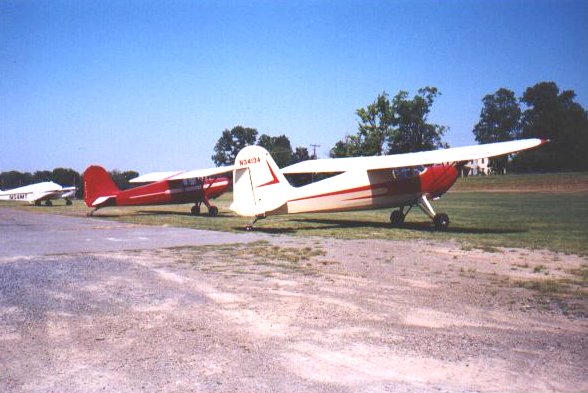
Two old ladies strut their tails. The "giveaway" in identifying a Commonwealth is the huge vertical stabilizer and the comparatively small rudder.
Pilots as a group, are an older bunch, and many of the older ones have an affinity for the "taildragger" type planes that were much more common 'years back. I took a picture of a few pilots and airplanes last Saturday and couldn't help but notice that the 55 year old planes were the younger than any of the pilots standing around them. One of the guys wore a T- shirt that said "Old men drag their tails at Kline Kill Airport".
For me, Kline Kill was just a name on the map, twenty miles southeast of Albany, until Saturday night when I started looking for a Sunday destination. The last week had been magnificent, with cool and sunny days, and I decided that it would be okay goof off on Sunday. I thought of a fellow named Al, the acknowledged guru of Commonwealth Airplanes, and called to see if he was going to be at his airport on Sunday. He replied "Sure... but I'm going to a picnic at Kline Kill, how about we meet there?"
The picnic was a simple get- together for a bunch of the local EAA guys, pilots who build their own airplanes, or do their own restoration work on older factory- built airplanes. There were several examples of homebuilt and restored planes, and several other planes that are presently in the throes of birth or rebirth. Other planes flew in, and by coincidence I arrived amidst Al and two others based twenty minutes away in North Adams Massachusetts.
I had enjoyed the two- hour flight over there, traveling over the northern edge of the Catskill Mountains. The day was still cool and I was still fresh. I sat happily and watched landmarks emerge from the unfamiliar terrain below, while the plane held a steady course through the smooth air. I sliced diagonally across I-88 between Sidney and Oneonta, passed the Schoharie reservoir on schedule, and crossed the Hudson at Coxsackie. Little airports can be hard to find, but Kline Kill popped right out of the scenery for me, just west of Chatham.
I have spoken with Al several times since I bought my plane. I had never met him, although I have long suspected that he is an interesting fellow. He started out as a machinist, but luck and circumstance caused him to become more of a designer than a mere parts maker. One of his crowning achievements was creating a machine that helps make some of the tiny parts that are soldered to electronic circuit boards. At the other end of the scale, he made several machines that helped automate a bakery.
I also know him as the guy who built a merry- go- round for his hangar. Airplanes fit well into a pie- slice segment of a circle, and Al built a rotating circle that was big enough to hold five planes. Each plane is backed into its own pie- slice of this turntable in his hangar, and the turntable can be rotated to bring any one of them to the door. As a side benefit, there is plenty of shop and storage space in the four corners of the hangar. He has several other small planes besides his Commonwealth, which he bought and flew home from Ohio in the early 1960s as a student pilot.
There were other guys there, all with their own stories and capabilities, and I hardly got to talk with them. One of them was a young man when he rode an incredible six missions over Ploesti as a B24 gunner. Someone who is obsessed with airline security would benefit from the perspective in this fellow's eyes.
On the way home I thought about the thriving little airport I had just visited, and of the people I had met. The flight started out to be pleasant, and I was surprised that the headwind was not as strong as I thought it would be. Soon though, all I could think about was "Old Men Drag Their Tails..." The plane was hot and noisy, and my legs had grown tired of being scrumped up. The lumpy air of a summer afternoon had arrived as usual, but the bumps were augmented by waves in the air.
Something, not just the Catskills, had perturbed the flow of air that I was flying into, and the air was rippled just like the water in a creek downstream of a submerged boulder. The plane would enter sinking air and lose altitude. I would have to pull back on the stick and add power to hold altitude, but soon I would enter rising air and would have to cut power and push the stick forward.
Back and forth, up and down, engine noise then airspeed noise. Lump and bump, and then the nose would wallow because the plane is too cramped to keep your feet available to work the rudder pedals along with the stick . My arms chafed against my knees as I worked the stick, and the cola that I had spilled made everything sticky. The air outside was a fairly cool 70 degrees, but it took so much of it to flush out the heat of the sun and the engine, that it too became annoying. For the first time in my life I longed for an autopilot to fly the plane while I found a comfortable seating position and savored the pleasant Sunday picnic I had just left.
The familiar hills of home eventually emerged from the haze ahead, and my plane and I soon dragged our tails into the hangar. I was happy to be on the ground, but happier still to have made the trip.
Two old ladies strut their tails. The "giveaway" in identifying a Commonwealth is the huge vertical stabilizer and the
comparatively small rudder.
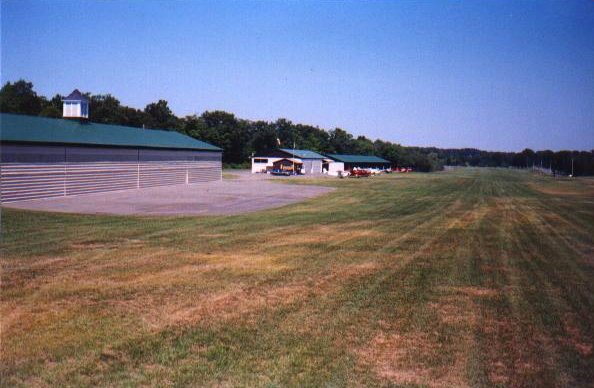
The south half of Kline Kill Airport, from the center of the runway. Aviation's muscle flies in and out of the big metropolitan
airports, but I still say that aviation's heart is at the peaceful and friendly grass airports.