COMMONWEALTH AIRPLANES
The "Commonwealth" was originally designed and manufactured by the Rearwin Aircraft
Company of Kansas City, Kansas, and first flew in 1940. 82 Rearwin Skyrangers were produced from 1940 until late
1942 when production was pre-empted by the demands of WW II.
As the nation retooled itself for wartime production, Rearwin was assigned many aircraft
manufacturing and repair contracts, most notably production of the CG4A gliders. All Rearwin
assets and interests were purchased by Empire Ordinance soon afterwards, and the new company was
operated as Commonwealth Aircraft.
After the war was over, Commonwealth resumed production of Rearwin's Skyranger as the
Commonwealth Skyranger 185 in December of 1945. Most all the original tooling and jigs were
scrapped during the war, and nothing was left of Rearwin's marketing and distribution system.
Commonwealth's first production run was almost hand- made at Kansas City's Fairfax airport before production
was moved to the former Columbia Aircraft factory in Valley Stream New York,
Just east of today's JFK Airport.
Commonwealth went on to manufacture 276 of their Skyrangers before production ceased in
October 1946. I would estimate that 50 of the original 358 Commonwealths and Rearwins still fly
today.
The airplane was a shade fancier than most of the planes in its class, featuring an 85 horsepower
engine with electric start, two place side- by- seating, lights for night flying, and an upholstered
interior. The electrical system made installation of radios a popular option. Typical of the times, the
planes were constructed of a steel tube fuselage and all- wood wings, all covered with aircraft
fabric.
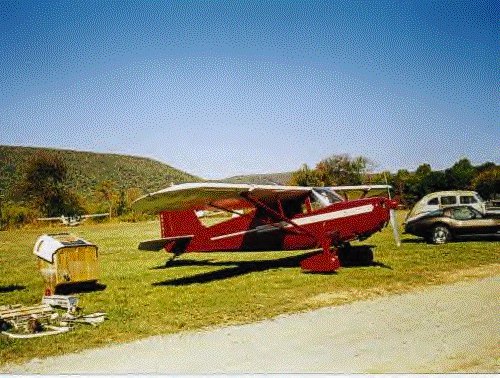
This is the first time that I laid eyes on the plane that I would own just a few hours later. It sat
between an almost- flyable Piper Pawnee and some collectable cars. This was definitely a buyer's auction; parts and winter projects
were changing hands at whistling- low prices. I was with a pair of wheeler- dealers who were getting nervous that they might go home empty handed.
My particular plane rolled out the doors of the Valley Stream factory on July 12, 1946 and was sold to
an operator in Belfast Maine. It knocked around New England among 15 owners for the next 30
years before being damaged in a taxi accident in Towaco, NJ. The plane was removed to the
owner's garage for repairs which lingered.
Several years later the dismantled airplane changed hands in a barter deal, and the new owner
repaired and restored the engine and airframe, returning it to the skies in 1988. It was then owned by several more parties before I
found it at an auction in October 1997. I am the twentieth owner, and the plane has flown a total
of 1700 hours; its records show many spells of loneliness and neglect.
In acquiring this airplane I violated every common- sense wisdom that has ever been offered
regarding such purchases. I bought a strange airplane, without even looking at its logbooks. It
had defects that were obvious even on a cursory inspection, and it had a paint job which had never
taken flight. It is a deep and lustful red, used car dealers often refer to it as "retail red".Were I
not a mechanic employed amidst a continuous stream of used but serviceable parts, the necessary
repairs could have exceeded the cost of the plane.
Stories of the airplane's acquisition and repairs can be read at "A Change in the Weather","Three Men and a Checkbook", "Satisfaction",
"Friends", "Phil's Wisdom",
"Mystery Lady", "Ben Franklin Fixes a Starter"
, "I Hate Aircraft Radios", "Shakedown Cruise",
"A Sensuous Visitor",and "Another Withering Skill".
Plane Talk View the Archives
Return to the Home Page
To contact Bob Tilden, send an e-mail.