
 Bob Tilden
My yard-art cow has brought me more fame than almost everything else I have done. It sits at the end of my driveway and has become a sort of landmark. Built from salvaged materials, it stays true to the philosophy that a project built from scrap is far more worthy than one from store-bought materials.
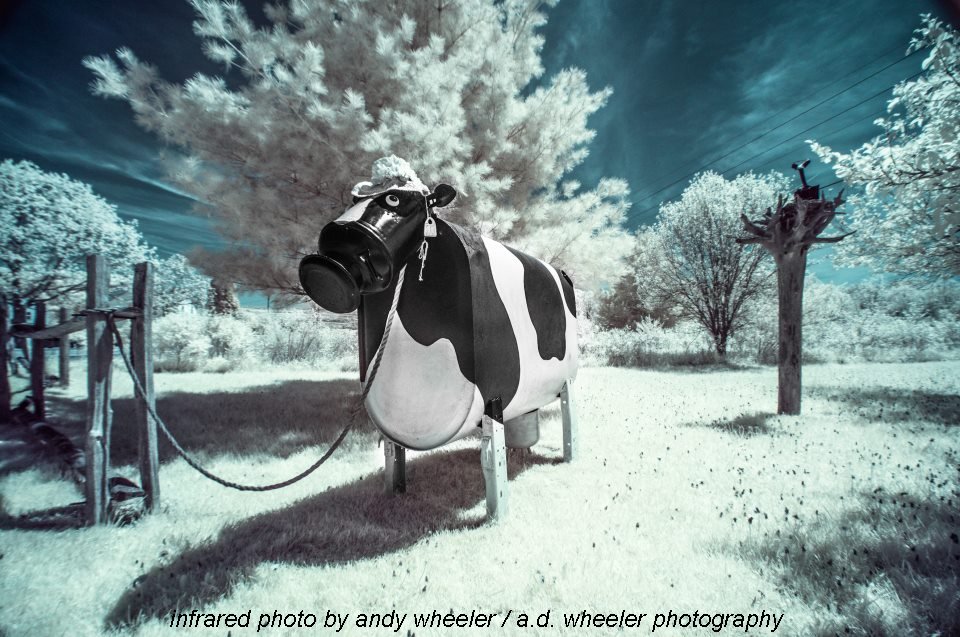
YARD ART
at the Tinker and Fiddlewith corporate campus
3640 County road 16, Montour Falls NY
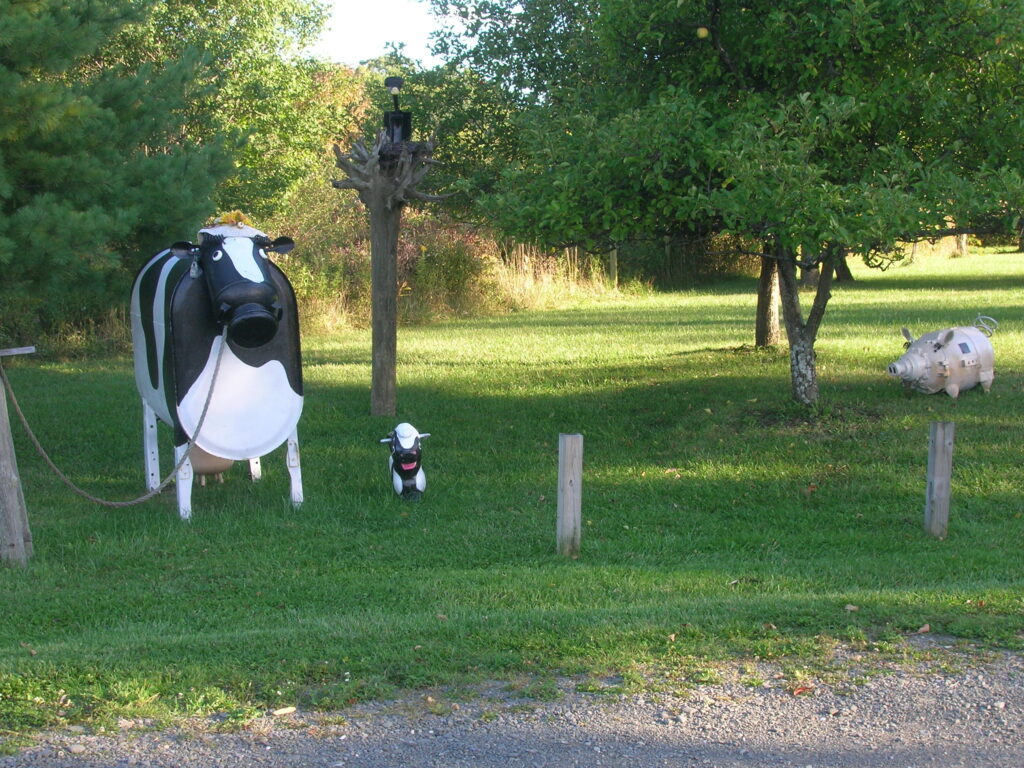
THE FARM, autumn 2012.
THE COW
People see the cow and accuse me of having too much free time. Not so. I was on a mission to help my son Brian, who was selling used cars at the end of our driveway at the time. The cow would be a great gimmick, I thought. We argued about it… he thought it was stupid.
In early 2006 he and his wife went on vacation for a week, and I spent the time building the cow in his absence, so that he coould return and see the completed creation, rather than just my description. I knew it would be a winner.
He hated it. He hated it so bad that he “prohibited” me from having it anywhere on my property where his customers could see it. Fat chance of that happening, but I did lay low for a while. My last chance was a bit of photoshop work, in the picture below…
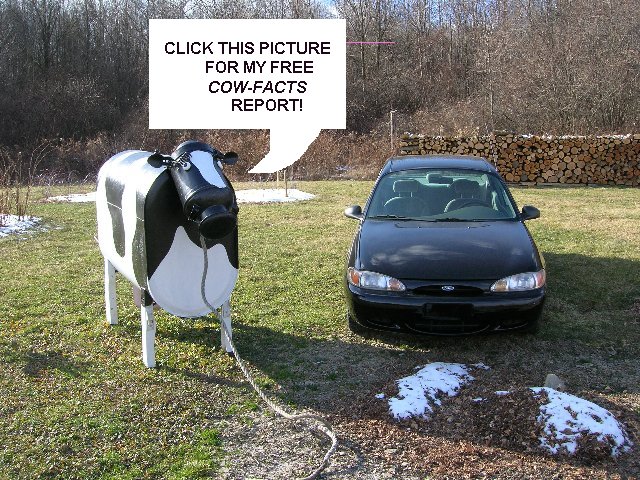
Cowabunga! What a gimmick I had for him, and he still spurned it. In the meantime everyone else was raving about it. Later that year I took her down to the Dann reunion, where our dairying family loved her.
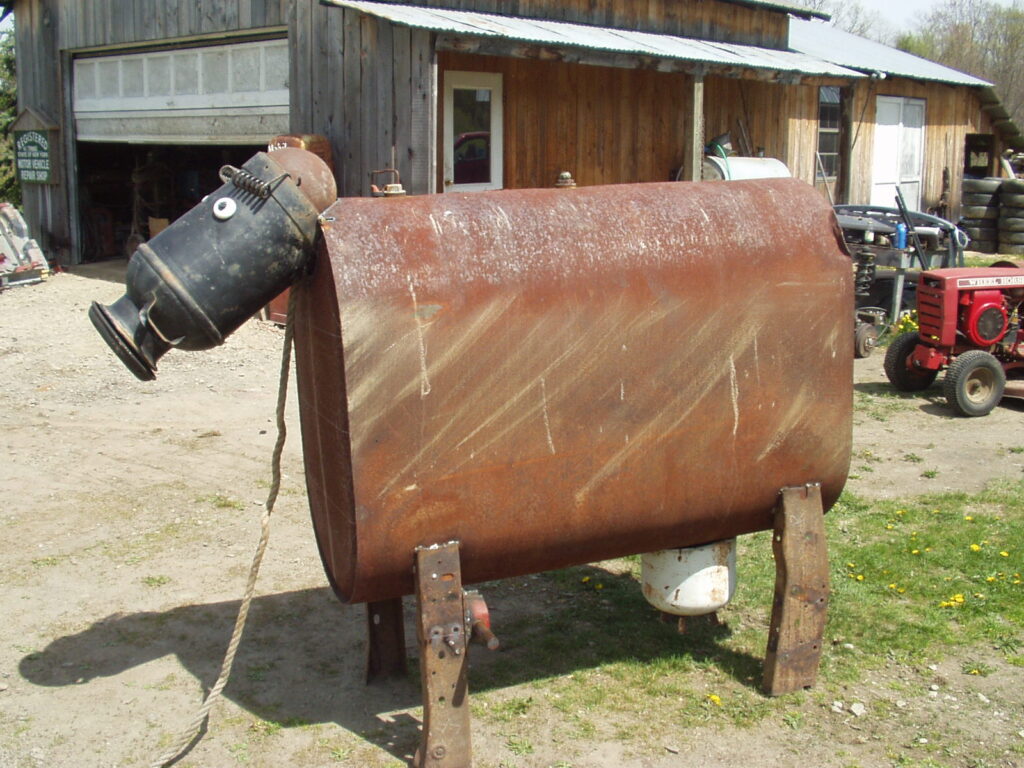
The cow is assembled. The body is a discarded fuel oil tank, and the head is an old mulk can. Eyelashes are hayrake springs, eyeballs are door knobs, and the back of her head is a cast iron drinking bowl from a stanchion assembly. The legs are cut from the frame of a Ford Ranger, and the udder is a 5 gallon propane tank. Not shown is the tail, which is a length of fat rope with a fray at the end, Also not shown is a pink stove trivet just below the tai
The farm at the end of or driveway, summer 2012: The cow and her calf, the pigunder an apple tree, and the shovel bird watching from its nest. The calf came directly from the scrap yard; it is a cast aluminum “kiddie ride” and was originally mounted on a heavy spring that would allow it to rock. I think it was supposed to be a deer, but it responded well to black and white paint.
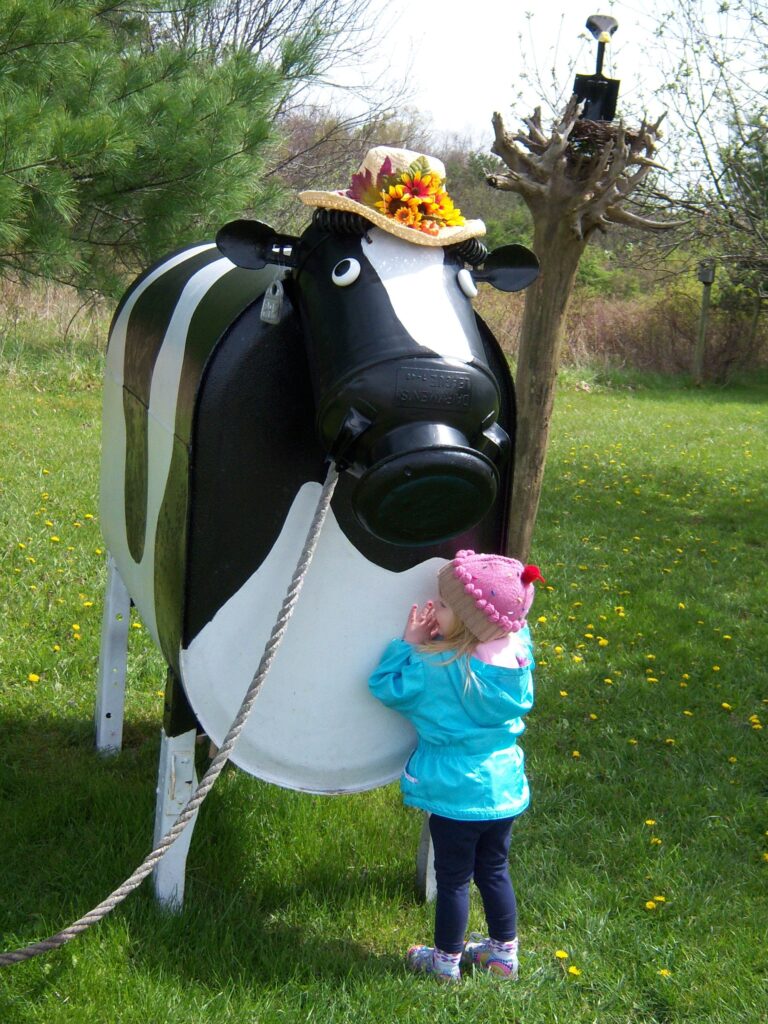
Sweet revenge… Brian’s daughter has loved the cow for every one of her three years; she is hugging it here.
The cow’s ears are cultivator sweeps, and her earrings are the ID tags that cows used to have around their necks. The hat is because it is springtime
In the background is a long- dead locust tree that has been planted roots- up, so that our shovel bird can make her scraggly nest there. As a youngster, Brian welded up the bird from a shovel, a bicycle fork and seat, and some old bolts.
THE PIG
This pig had an unusually long gestation. All the parts for the pig were piled in front of my shop for the entire four years that I promised friends and neighbors that construction was imminent. As the years flew past, I progressed well into my 60s, and the parts that were almost too heavy to handle started to feel like they were frozen to the ground.
My son rescued the project when he asked what I might like for father’s day. I looked him in the eyes and said help me build the pig. His eyes rolled, but he realized that a worse request could have been made. He could help me and get rid of the pile of parts. He would also score big points with Mother, who would be awash with waves of rapture to see the mess disappear.The body was made from the end castings of two WW2 era generators, bolted together. They make a good approximation of a pig’s body shape, and they weigh at least as much. The ears are cultivator sweeps, the eyebrows are hayrake springs, the tail is from a car suspension, and the face is the clutch casting from an old Chris- Craft. The pig stands on a set of clawfoot bathtub legs.
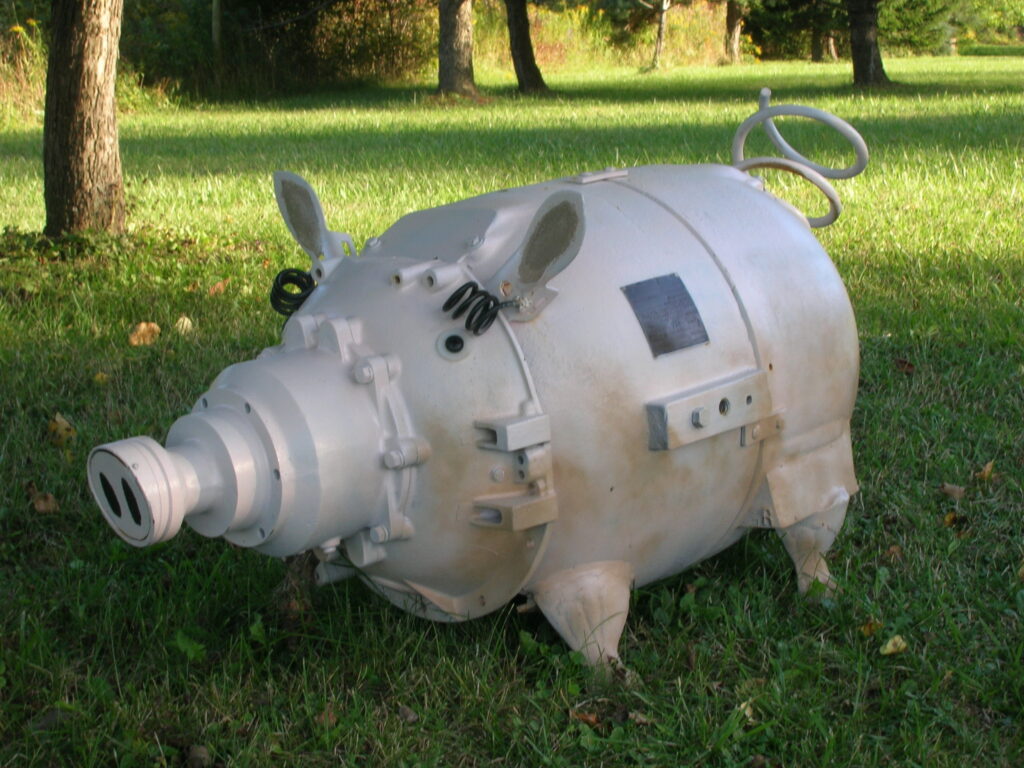
As I mentioned, the gednerators were WW2 era. One of them still retains a brass tag showing that it was overhauled at the Hanau Engineer depot. I googled it, and read that after the end of the war, the Army made a major effort to round up all its “assets” that were lying idle and forgotten accross the continent. The Hanau depot in Germany was one of the locations where this equipment was gathered for disposal, salvage or overhaul to new specifications. The generator was returned to the U.S. and later released to the Dundee airport, which was “sort of” municipal at its outset. For many years, if not decades, it powered the airport when electricity was needed for lights, airplane maintenance, or for pancake breakfasts.
After serving the Dundee airport for so many years, it moved to Larry Huntley’s airport on a hilltop near Tyrone for several more years. When it landed in my yard, it was all worn out. Most of it went to the salvage yard, some of it awaits repurposing in my shed, but the cast iron end bell is alive and healthy in my front yard!
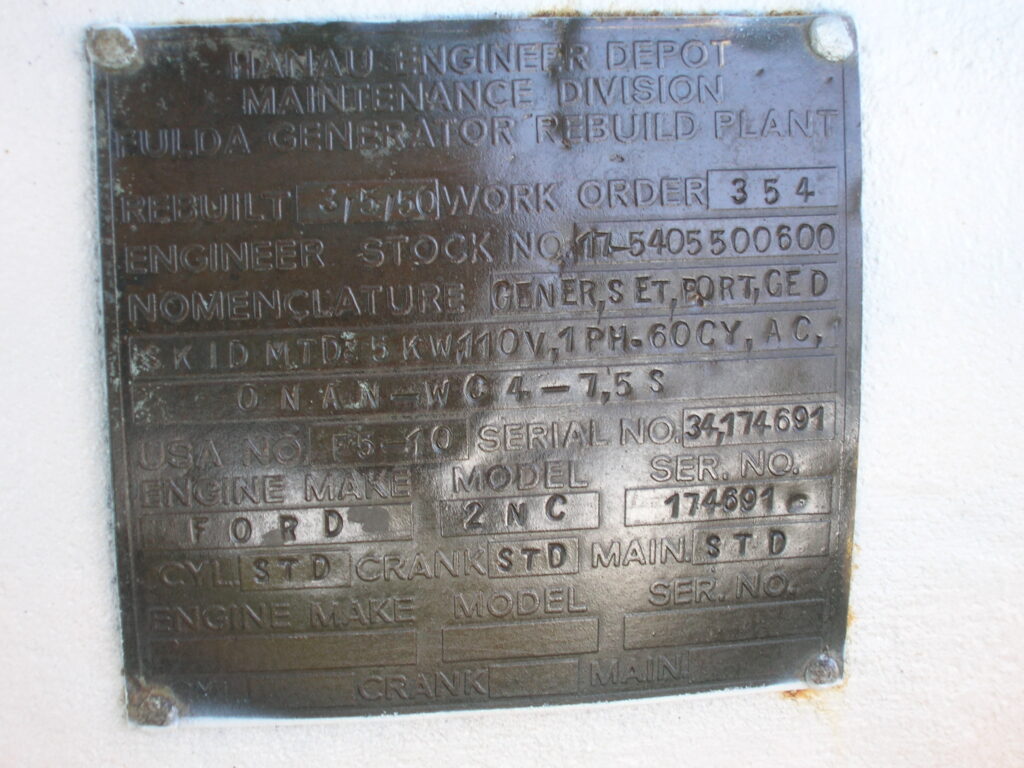
A close up of the Hanau overhaul tag.


Add comment